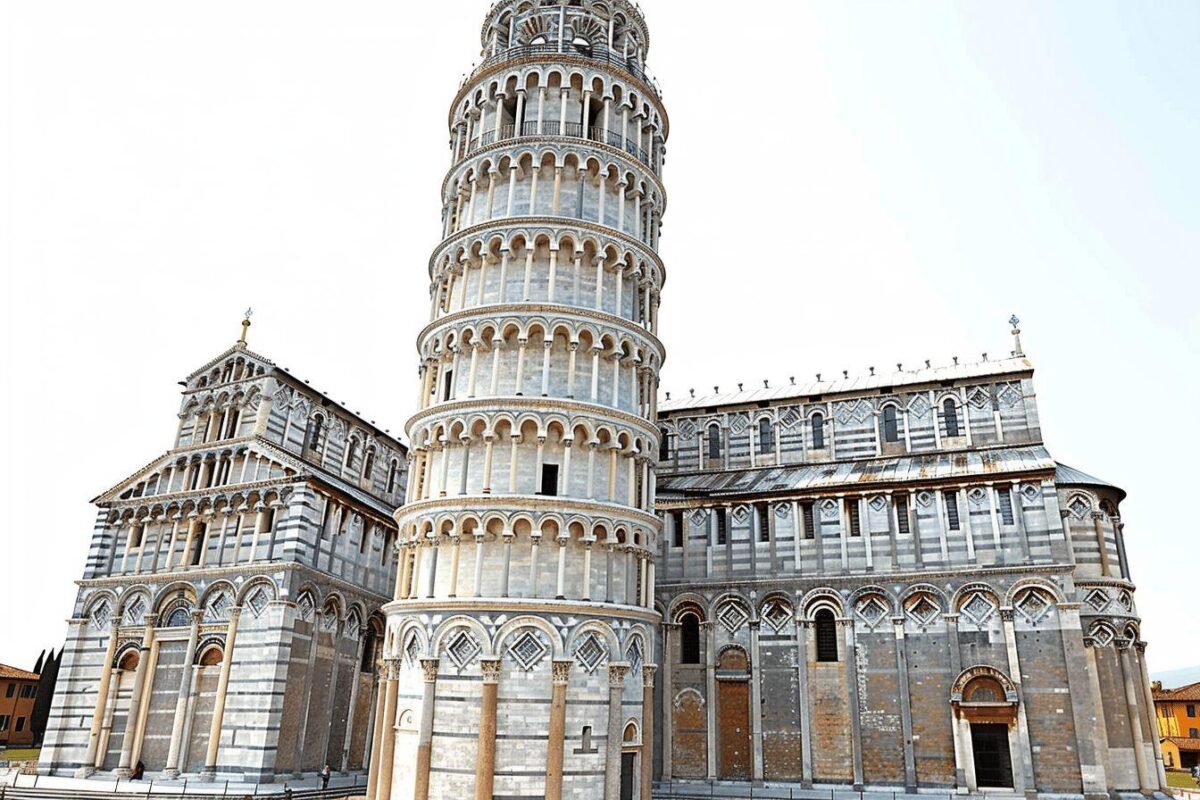
Secrets revealed: Why is the Tower of Pisa leaning?
|
IN SHORT |
|
Secrets revealed: Why is the Tower of Pisa leaning? |
| Popular theories | The Tower of Pisa is leaning due to an unstable foundation and the ground collapsing under its weight. |
| Recent research | Studies suggest that the main component of turnover is due to soil quality and water accumulation in clay soil. |
- Construction on unstable ground: The tower was built on low density soil which began to subside from the start of its construction in 1173.
- Design errors: Engineers at the time made calculation errors in the tower’s design, which contributed to its tilt.
- Stabilization works: Stabilization work was undertaken over the centuries to prevent the tower from collapsing, but also contributed to its current tilt.
- Preservation Efforts: Continuing efforts are being made by Italian authorities to keep the tower secure while preserving its characteristic tilt.
Origins of the tilt of the Tower of Pisa
There Pisa tower owes its famous tilt to several historical and geological factors that combined in a unique way. Built in the heart of Italy, this architectural marvel attracts millions of visitors curious to understand this fascinating phenomenon.
The main cause of the tilt is the ground on which the tower is erected. The Pisa region is characterized by terrain made up of alluvial deposits and clay. This type of soil, particularly soft and unstable, was not able to support the massive weight of the construction materials.
Construction work began in 1173 under the direction of the architect Bonanno Pisano. Just a few years after starting, near the end of the second floor, the floor began to subside. This phenomenon led to a progressive and irregular inclination of the structure.
In addition to the ground, several human errors accentuated this inclination. For example, architects and engineers of the time attempted to correct the tilt by adjusting the height of columns and walls when constructing different floors. These adjustments paradoxically worsened the imbalance of the tower.
The disruption and referencing work spanning nearly two centuries also played a crucial role. The period of inactivity allowed the ground to settle, however, each resumption of work destabilized the building again.
Finally, modern interventions have made it possible to stabilize the Tower of Pisa. At the end of the 20th century, engineers used different techniques to reduce its inclination and strengthen the foundations. These efforts have ensured that the tower continues to appeal without risking structural disaster.
In summary, the Tower of Pisa remains a unique example where geology, construction errors and preservation efforts meet. It is these combined elements that give this building its worldwide fame and undeniable appeal.
Unstable foundations
There Pisa tower, an architectural jewel of Italy, intrigues with its unusual inclination which defies the laws of gravity. Built in the 12th century, it has captivated generations with its unique appearance. But why this inclination?
The reasons for the inclination of the Tower of Pisa go back to its origins. From the start of its construction in 1173, problems arose. This is largely due to the foundation and soil on which it sits.
THE foundations of the Tower of Pisa are shallow, only three meters deep, which is insufficient to support such a massive structure. The ground under the tower is composed mainly of clayey soil, which proved far too soft to provide a stable base.
As work progressed, engineers noticed that the tower was beginning to lean towards the north. Attempting to correct this tilt, they added more material to one side than the other, but this only made the problem worse, changing the tilt to the south.
To summarize the main elements that led to the tilt of the Tower of Pisa:
- Shallow foundations
- Unstable clay soil
- Miscalculated human interventions
Over the centuries, various interventions have been attempted to stabilize the tower and prevent disaster. Today, thanks to the combined efforts of various engineers, the tower is safe and its tilt is stabilized, continuing to fascinate visitors from around the world.
Architectural choices
There Pisa tower, known worldwide for its inclination, owes this particularity to a series of historical and geological factors. Its construction began in 1173, and from the first phases, signs of weakness were observed.
The main culprit is the clay soil on which the tower is erected. The Pisa region rests on a base of marine sediments and alluvial deposits, rather unstable terrain to support such a monumental structure. This soil caused a subsidence from the construction of the first floors.
In addition to the nature of the ground, the absence of a sufficiently deep base contributed to its inclination. The foundations are only buried to a depth of three meters, far from what would be necessary to stabilize a 56-meter-high tower.
The architectural decisions made during construction also played a crucial role. The architects attempted to compensate for the inclination in the upper floors by building them against the slope, which however created an additional imbalance.
Over the decades, several interventions have been carried out to stabilize the building. Here are some of the methods used:
- Addition of counterweight in lead and concrete on the north base.
- Excavation of earth under the foundations to allow rebalancing.
- Reinforcement of the structure with steel cables.
These efforts helped reduce the tilt by several degrees and secure the tower for future generations. The Tower of Pisa continues to fascinate with its unique history and the challenges it has overcome.
Q: Why does the Tower of Pisa lean?
A: The Tower of Pisa is leaning due to the unstable ground on which it was built. Additionally, its initial design also contributed to its tilt.
Q: Is the Leaning Tower of Pisa safe to visit?
A: Yes, despite its inclination, the Tower of Pisa is secure and professionals continually work to preserve its stability for visitors.
Q: Will the Tower of Pisa continue to lean further?
A: Steps have been taken to stabilize the Tower and it is unlikely it will lean further in the future.
Q: Why is the Leaning Tower of Pisa such a popular site?
A: In addition to its unique tilt, the Leaning Tower of Pisa is also known for its remarkable architecture, making it a must-see for tourists from around the world.
